jueves, 17 de febrero de 2011

Cracovia - capítulo 3: la ciudad del Krak / Kraków - chapter 3: Krak's city

Kraków, que significa "la ciudad del Krak" en honor al rey Krakus que fue su fundador.

Así que voy a contaros como es la plaza mayor de Cracovia, la más grande de Europa:

En el centro tenemos la Lonja de los Paños (Sukiennice), que era donde se vendían antiguamente los telicas y esas cosicas y ahora está repleto de tiendas de recuerdos, que son un poco caras pero dicen que el regateo funciona, sobre todo se venden joyas de ámbar.
-----------------------------------------------------------------------------------------------------
Well, and after a "little" break, I will come back to the beginnings, Kraków, that means "krak's city" because of the king Krakus, its founder.

So now I'm gonna tell you how is the biggest main square in Europe, Kraków's main square:

In the middle we can find the Cloth Hall (Sukiennice), where long time ago they sold fabrics and this kind of things and now is plenty of souvenirs shops, a little bit expensive but the people say haggling works there, specially they sell amber jewelry. 


 Al lado está la Torre del ayuntamiento que es lo único que dejaron de él al destruirlo en 1820.
--------------------------------------------------------------------------------------------------
Next to this place we can find the Town Hall Tower, is the only part of the Town Hall that was not destroyed in 1820.


Luego nos encontramos la iglesia de Santa María (Kościół Mariacki) que tiene dos torres desiguales, ¿por qué queridos niños y niñas? pues cuenta la leyenda que había dos hermanos que se querían mucho, y el mayor de ellos era el constructor de la Iglesia, así que le enseñó a su hermanito pa que le echara una mano, y porque hacer cosas en familia es mu bonito, ya lo dicen las películas, total que como suele pasar el pequeño superó al grande y empezó a hacerlo mejor, y como la envidia es mu mala, el otro se enfadó y le mató.

En la Iglesia de Santa María cada hora se puede oír una trompeta, la melodía parece quedar incompleta, y ¿por qué queridos niños y niñas? pues como el 90% de las cosas en Cracovia, también se explica con una leyenda. Cuenta la leyenda que venían los tártaros y un hombre muy valiente (para cuando una leyenda cracoviense en la que sea una MUJER muy valiente la que salve algo o a alguien?) se puso a tocar la trompeta para alertar a la población y cerrar las puertas de la ciudad, y así salvo la ciudad, pero una flecha le alcanzó en mitad de la melodía y por eso la melodía queda incompleta!
-----------------------------------------------------------------------------------------------------
Then we can see Saint Mary's church (Kościół Mariacki) with two unequal towers, why my dear lovely kids? because as the legend says there were two brothers and they had a very good relationship, the older one was the church builder so he tought his brother how to make it to help him, because he needed help and is very lovely make things with the family, or you haven't see that on the movies? as usual the younger was better than the older so the older got really angry, and envy is so so bad that he killed his own brother!!!

In Saint Mary's Church each hour you can hear a trumpet, and the melody sounds incompletely, why my dear lovely kids? of course its explanation will be by a legend! The legend says that tartars where coming and there was a really brave guy (I'm still waiting to find a legend from Kraków with a really brave LADY, who saves everything?) so he began playing the trumpet to warn everybody and close the city doors, and he saved the city, but!!! an arrow reached him and that's the reason why the melody is incompletely!


Y por último, la iglesia de St. Adalbert (en polish kósciol sw. Wojciecha) que fue un obispo muy querido por convertir a la gente al cristianismo por aquí, asi que le canonizaron y todo! y para terminar el recorrido también encontramos una cara (que salía una de las fotos de mi segunda entrada) pues el autor se llama Igor Mitoraj escultor que estudió en Cracovia y hay esculturas de caras suyas en muchas ciudades, incluso las podemos encontrar en España, sólo hay que buscar!
-------------------------------------------------------------------------------------------------
And finally, St. Adalbert Church (in polish Kościół sw. Wojciecha) he was a bishop and everybody loved him because he converted a lot of people to Christianity here so he was canonized! and for the end of the tour we also find a face (which was in one of the pictures in my second entry) the author is called Igor Mitoraj sculptor who studied in Krakow and there are sculptures of their faces in many cities, even we can find them in Spain is just begin to search!


¿Y quién es el hombre de la última foto?
------------------------------------------------------------------------------------------
And, who is the man in the last picture?


                                                                                                                 CONTINUARÁ...
-----------------------------------------------------------------------------------------------------
                                                                                                                 TO BE CONTINUED...


sábado, 18 de diciembre de 2010

Cracovia - capítulo 2 / Kraków - chapter 2: Wawel i Smok Wawelski

En la colina de Wawel se encuentran el Castillo Real y la Catedral de Wawel, símbolos ambos dos de Cracovia.  El Castillo Real tal y como su nombre indica es donde vivían los reyes de Cracovia y la Catedral es un santuario nacional polaco, lugar donde se coronaba antiguamente a los reyes y donde están enterrados muchos de ellos. También es donde está enterrado Lech Kaczynski lo cual creó y crea mucha polémica. 

-----------------------------------------------------------------------------------------------------


On the Wawel hill, are situated the Royal Castle and Wawel Cathedral, both are symbols of Kraków. The Royal Castle as you can imagine is where the kings and queens lived in Kraków, and the Cathedral is a Polish national shrine, where long time ago the kings where crowned and where most of them are buried.  Also there is buried Lech Kaczynski, which created and creates much controversy.


La catedral y el castillo están construídos sobre.... la cueva del dragón!!!!!

Habia una vez queridos niños y niñas un dragón muy malo, muy malo, muy malo al que le gustaba comer gente en Cracovia, su plato favorito eran las jóvenes vírgenes, así que como le gustaban mucho se las comió... a todas! A todas menos a la hija del rey, por su puesto (sino menuda mierda de leyenda, no?). Así que el rey estaba muy muy muy asustado y por eso les dijo a todos los caballeros que le daría la mano de su hija al que matara al dragón (la mano luego el resto del cuerpo, pues ya se vería) y todos lo intentaron pero claro el dragón tenía fuego en la boquita así que los mataba a todos. Entonces llegó un aprendiz de zapatero llamado Skuba Dratewka y dijo venga ahí voy yo, y le dio al dragón un cordero relleno de azufre de regalito en la puerta de su cuevita, así que el dragón se lo comió y claro estaba tan mal que empezó a beberse el Vístula (que es el río que pasa por Cracovia y estaba al ladito de su casa), pero el agua no era suficiente así que bebía y bebía hasta que explotó!!!! y así el aprendiz de zapatero se casó con la princesa, igual luego no se aguantaban y el pobre Skuba se arrepentía de haber matado al pobre dragón, pero queda mejor decir que vivieron felices y comieron perdices.

-----------------------------------------------------------------------------------------------------


The Cathedral and the Castle are built on.... the dragon cave!!!!

Once upon a time dear boys and girls there was a very very very bad dragon who loved eat people in Krakow! his favourite food was young virgin ladies, so he ate all of them! Except (of course, if not what kind of legend is this one?) the king's daughter. So the king was very very scared, for that reason he announced that his daughter will get married with the person who'll kill the dragon (I'm sure he didn't ask his daughter about that) so a lot of people tried but they failed because the dragon had fire on his mouth! and he killed them all! Then a shoemaker's apprentice whose name was Skuba Dratewka let the dragon a lamb with sulfur inside in the door of his cave, the dragon ate it and he felt so so bad that he began to drink the Vistula river (is the river of Krakow and it's very closed to the dragon's cave) but water wasn't enough so he drank and drank and he.. exploted!!!!!!!! so the shoemaker's apprentice get married with the princess and maybe they were not happy at all together but is better to say they were very very very happy together!


domingo, 28 de noviembre de 2010

Auschwitz-Birkenau

A casi 70 kms de Cracovia, en Oswiecim los nazis construyeron en 1940 Auschwitz, en un principio era una especie de cárcel para prisioneros políticos polacos. Pero más adelante se convirtió en un campo de exterminio principalmente de judíos pero también de homosexuales, gitanos, etc.

La descripción del lugar es demasiado desagradable y también bastante conocida por todos, aunque sea sólo por las películas. Sólo decir que hay que verlo en persona una vez en la vida para ser realmente consciente, una vez que estás allí y te cuentan y ves todas las barbaries que alli se cometían, las diferentes torturas, las condiciones de vida, los experimentos que Jozef Mengele hacía allí, etc. Es muy impresionante.

Cuando estás allí realmente te preguntas como es posible que algo así pudiera pasar, cómo tanta gente ayudó a que eso funcionara, para ello os recomiendo leer algo sobre el experimento Milgram, el experimento de la prisión de Stanford que realizó Philip Zimbardo, o el experimento "la Tercera Ola" llevado a cabo por el profesor de historia Ron Jones en un instituto y que fue llevado a los cines bajo el nombre de "la Ola" ("Die welle" en la versión original).

-----------------------------------------------------------------------------------------------------

In Oswiecim around 70 kms from Cracow, Auschwitz was built by the Nazis in 1940, at the beginning it was just for Polish political prisoners, but later it became a death camp for jews and also homosexuals, romanies, etc.

The description of that place is too much disgusting and quite well known for everybody, because of the films and so on. I just want to say that you have to go there once in your life time to realize that, actually you can never be completely conscious of that, once you are there and you know all the horrible things that happen there as tortures, the way the lived, Mengele´s experimentes, and so on. Is very impressive.

When you are there you ask yourself how that could happen, how so many people work to make that true, I just can recommend you to read about Milgram's experiment, the Stanford prision experiment by Philip Zimbardo, or the experiment called "the Third Wave" by Ron Jones, a history teacher in a high school, the film "The Wave" ("Die welle" in the original version) was based on that experiment.


sábado, 27 de noviembre de 2010

11 de Noviembre día de la Independencia / 11th November, Independence day

En 1795 Polonia desapareció del mapa durante 123 años, ya que fue comida por sus vecinos Prusia, Rusia y Austria, aunque el país siguió existiendo como entidad espiritual y cultural y se crearon varias sociedades nacionalistas en secreto.

Durante la primera Guerra Mundial estos países se pusieron a pelearse entre ellos, austrohúngaros y alemanes (incluida Prusia) contra rusos y amigos, y claro ya de ponerse a estropear algo pues luchaban en Polonia. Y como la cosa se complicó y cada país tenía sus propios problemas, Polonia pudo aprovechar y reunificarse.

Así el 11 de Noviembre de 1918 Józef Pilsudski tomo Varsovia declarando la soberanía de Polonia y autoproclamándose como jefe de Estado.

Polonia se viste de rojo y blanco ese día con banderas por todos lados y la gente en Cracovia se reúne en la plaza mayor y cantan canciones de tiempos de la guerra. Ponen una especie de karaoke enorme y en el escenario se puede ver gente vestida estilo militar y con trajes regionales. A la izquierda del escenario se puede ver un cartel con la imagen de Józef Pilsudski.

-----------------------------------------------------------------------------------------------------

In 1795 Poland disappeared from the map during 123 years, because their neighbours Prussia, Russia and Austria ate it, but the country continued to exist as a spiritual and cultural entity during that time and they were created some nationalist societies in secret.


During the 1st World War this countries fought between them, Austro-Hungarian and Germans (including Prussia) against Russia and friends, and of course if they were going to make damaged better do that in Poland. But everything got worst and each country had their own problems so Poland could take the advantage of that and was reunited.

So the 11th of November 1918 Jozef Pilsudski declared the soberany of Poland in Warsaw and proclaimed himself as the head of state.

Poland dresses white and red this day, and you can see flags everywhere. Also in Krakow the people go to the main square and sing songs from the war times. They make like a big karaoke and in the stage there are people dressing militar clothes and local costumes. On the left of the stage you can see the image of Józef Pilsudski.


miércoles, 10 de noviembre de 2010

Warszawa/ Warsaw/ Varsovia2

Bueno como lo prometido es deuda ahí va un breve recorrido por los sitios que he conocido en Varsovia y que creo que merece la pena ver.

Empezaremos por el primer sitio que conocí, el parque Lazienkowski, en el que se encuentra el Palacio sobre el agua (es ese edificio blanco) y está habitado por pavos reales, patos, pájaros y ardillas. (el parque, no el palacio, espero). También al lado tiene el museo de arte contemporáneo, donde puedes encontrar obras tan extrañas como una serie de fotos de una Barbie saliendo del aparato genital femenino, vamos para no perdérselo :)

-----------------------------------------------------------------------------------------------------

As I promised now is time to write about Warsaw, so here you have the places I have known in Warsaw and I think are worthy.

The first place I knew was Lazienkowski park, here you can find The Palace on the Water (the white building) it's inhabited by peacocks, ducks, birds and squirrels (the park not the palace, I hope). Here also you can find the Contemporary Art Museum, there you can see artworks as weird as pictures about a Barbie going out of a woman's genitals, so... so... disgusting!!


El Palacio de Cultura y Ciencia, el cual no es apreciado por mucha gente, puesto que para algunos es un símbolo del comunismo y para otros fue una inversión de muchísimo dinero cuando era necesario para cosas más importantes, para otros si es querido ya que es un símbolo de Varsovia (información sacada de la gente de Varsovia, en la calle). Dentro tiene de todo, hasta una piscina!

-----------------------------------------------------------------------------------------------------

Culture and Science Palace, this is not well-valued for everybody because some people think is a communist symbol and others that it was a big waste of money, but for other people is valued because is a Warsaw symbol (this information was from Warsaw people, on the street) and inside you can find a lot of things, even a swimming pool!!


Otra de las mejores cosas que se pueden visitar en Varsovia es el museo del Levantamiento de Varsovia, el cuál está muy bien organizado y te enteras bastante bien de como fue la historia. Y, sobre todo, si entras en la parte de 3D puedes hacer un viaje virtual sobre como quedó la ciudad tras la visita de los nazis, es bastante impactante. 

En resumen, de agosto a octubre de 1944 el Ejército Nacional luchó durante 63 días por la liberación de Varsovia de los nazis, lo cual según dicen podía haber sido fácil de no ser porque los amigos Stalin, Churchill y Roosvelt tenían otra idea...

----------------------------------------------------------------------------------------------------

Something you do have to visit in Warsaw is the Uprising Museum, is really well-made so you can understand quite well what happened. Specially if you enter to the 3D video, where you can do a virtual travel to Warsaw after the nazis "visit", is quite shocking. 

Briefly, in 1944 from August to October, the National Army fight to make Warsaw free of Nazis during 63 days, that could have been possible (that's what the history says) but Stalin, Churchill and Roosvelt had a differente idea for Warsaw future...


Y después os recomiendo pasear por las calles de la ciudad antigua y el centro e ir descubriendo sus callecillas que merecen la pena y algunos sitios que vas encontrando como el Castillo Real, o el Palacio de Tecnología con la estatua de Copérnico delante.

-----------------------------------------------------------------------------------------------------

And then I just recommend you, go for a walk on Warszawa streets, visit the old town and the center and discovered their streets, because they are quite pretty and there are some nice places you find on the way as the Royal Palace or the Technology Palace with Copernico's statue in front.


Zamek Krolewski/ Castillo Real / Royal Castle


Palac Staszica/ Palacio de Tecnología/ Technology Palace
Quedan muchas cosas que mostrar de Varsovia, como el barrio de Praga, el paseo del Vístula, la plaza del mercado, etc. Pero eso ya lo dejo para vosotros...

-----------------------------------------------------------------------------------------------------

There are another places to show from Warszawa, as Praga neighbourhood, Wisla, marquet square, etc. But now, but you will have to discover it by your own...


domingo, 7 de noviembre de 2010

Día de Todos los Santos / All Saints Day

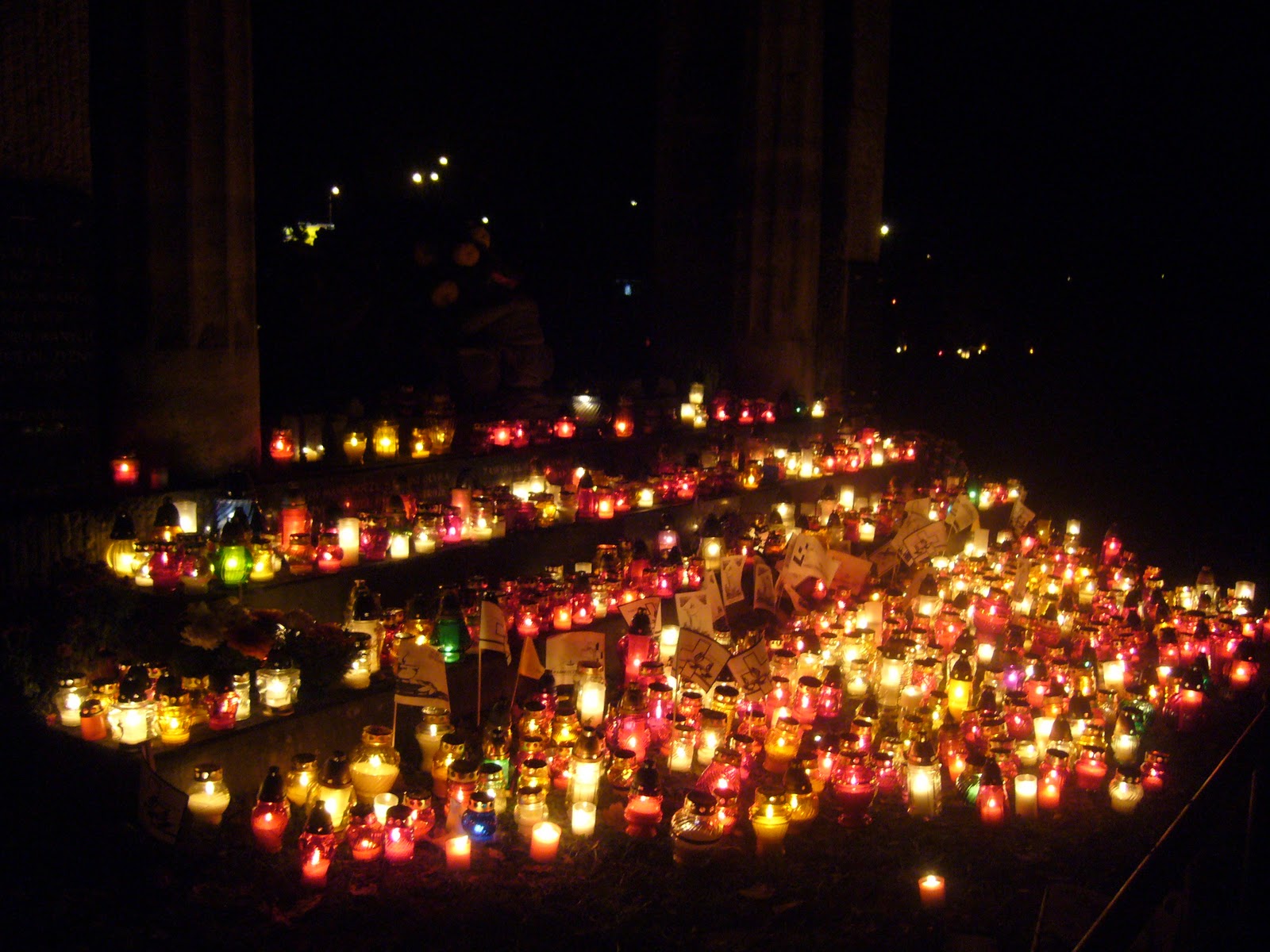
El 1 de Noviembre es el día de Todos los Santos, y en Polonia (país católico donde los haya) se celebra masivamente. La gente va a sus pueblos y ciudades de origen (generalmente) y pasan el día con la familia y amigos y juntos van al cementerio con velas y flores, es bastante impresionante ver todas las velas por la noche. 

¿Por qué se colocan velas junto a las tumbas? Porque así las velas iluminarán el camino del alma de la persona a la que pertenece la tumba hacia el cielo. 

Además ese día hay misas a todas horas y en el cementerio por megafonía se escucha la voz de un cura rezando, merece la pena acercarse y verlo en persona.
El día anterior es Halloween pero excepto por las calabazas en las fruterias y poco más, casi ni te das cuenta, muy muy poca gente se disfraza y la que lo hace, en general, no es polaca.

-----------------------------------------------------------------------------------------------------
The first of November is All Saints Day, and in Poland, one of the most catholic countries, is celebrating massively. All the people go to their villages and cities (generally) and spend the day with friends and family and all togheter go to the cemetery with candles and flowers, is quite impresive see all the candles at night. 

Why people put candles close to the graves? Because those candles will illuminate the path of this person's soul to heaven.

Also this day there are a lot of masses and in the cemetery you can hear the voice of a priest on the speakers, praying. Is really worthy to go and see that.
The day before is Halloween but except for the pumpkins at the shops and some people wearing costumes (most of them foreigners) you can't realize it.


lunes, 1 de noviembre de 2010

Warszawa/Warsaw/Varsovia 1

Y de Cracovia pasamos a Varsovia (donde no hay menos palomas!!!), capital de Polonia desde que se le ocurrio al rey Segismundo III Vaza trasladar la capital de Cracovia a Varsovia, lo cual hace que haya mucha rivalidad entre las dos ciudades. Es una de esas ciudades que te sorprenden, llena de enormes edificios y rascacielos, por supuesto, todos con su enorme letrero publicitario encima. Y, en medio de la ciudad, ¿qué creeis que puede haber...? UNA PALMERA!!!!!!!!!!! Sí, señores y señoras, los polacos querían decir algo asi como "¿Qué pasa? Aquí también tenemos palmeras" como para traer un poco de calor a estas gélidas tierras. Aunque mucha gente dice que Varsovia es bastante fea, tiene muchas cosas interesantes que visitar. Si sales de la zona central de rascacielos. Pero eso lo dejaremos para el próximo capítulo...


¿Sabíais que el polonio se llama así por Marie Curie (Marja Sklodowska antes de casarse)?  que fue una de sus descubridoras, y como es polaca (de Varsovia) en su honor le pusieron ese nombre.

-----------------------------------------------------------------------------------------------------


And after Krakow the next stop is Warsawa (with a lot of pidgeons as well!!) Warsawa is the capital of Poland since king Segismundo III Vaza though that could be a great idea to move the capital from Krakow to Warsawa, the people from Krakow don't think the same so there are a little bit upset about it and the relationship between both cities is not the best.  Warsaw is one of the cities that surprise you, with huge buildings, skyscrappers (each one with a huge advertising at the top). And in the middle of the city what you think you can find...? A PALM TREE!!!!!!!!!!!!!!!! Yes, laddies and gentlemen, Poles wanted to say something like "what happen? we have also palm trees!" to bring a little bit of warm to this frozen place. A lot of people say Warsawa is quite ugly, but you can see a lot of interesting places, but you have to go out of skyscrappers area. I will explain that in the next chapter...

And do you know what?  Polonium is called like that because of Marie Curie (Marja Sklodowska before she got married) she was one of the discoverers, and she is from Poland (Warsawa), so they put this name in her honour.